
The Beginning
The Ship Bombay was commissioned by George Dorman Tyser in 1860 to the Ship Builders Mr John H Vaux & Co. Ltd, for the grand price of £30,000. A princely sum, and difficult to equate to modern standards, although a useful comparison could be a made to the sale of a pleasant house in Holland Park, a (now) wealthy suburb in London for a cost of £10 pounds, in the same year.
John Vaux had recently leased the Royal Naval Yards in the coastal town of Harwich, Essex, England for the purposes of ship building, something that his son will continue to do after John senior’s death in 1874. The Yard, formally known as the King Yard had a long tradition of boat building and was particularly active in the 17th and 18th Century’s for the construction of Royal Navy Warships, including HMS Resolution, Centurion and Conqueror to name a few. Below is a photo of the present-day location of the Yard, still in active operation as a working Dock, operating cargo vessels to Belgium and Scandinavia.

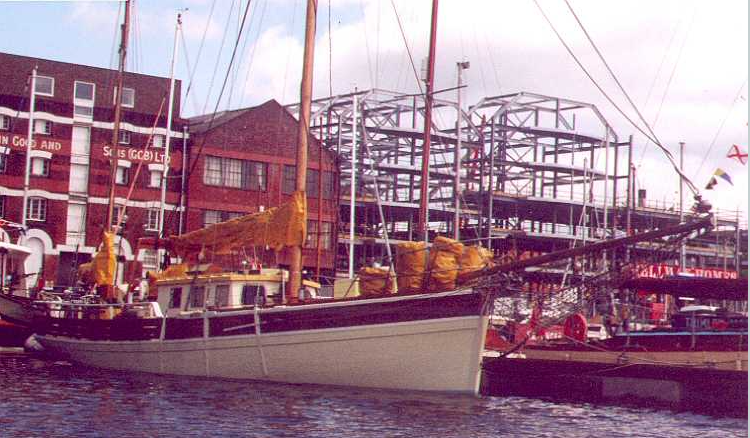
The Bombay was the first Ship built by the Vaux family, launching in January 1861 and completing fit out the following month. The family will earn a fine reputation for boat building, and will construct many fine Schooners, Barges and of course larger sailing Ships like the Bombay. The last recorded vessel built in the Yard by the Vaux’s was the Barge Dunkerque in 1894. But the last known survival of a Ship built by the family would be the Auto Da Fe, meaning Act of Faith, she was used as a fishing boat up to 1953, almost 70 odd years, before becoming a vessel of pleasure, where she would become well known for her speed, winning several Regattas. Below is the Auto Da Fe, Pictured in 1999 in Ipswich, England.
Construction
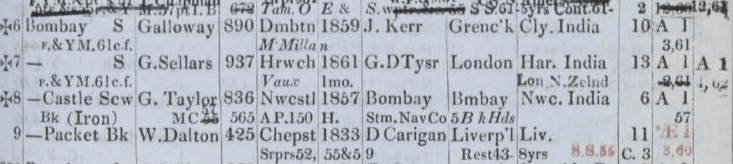
The Bombay on completion of building in February 1861 was given the Registration Number 29383 and is listed in the Lloyd’s Register of British Shipping of that year. It was listed as fully rigged Sailing Ship of English Oak and Teak, Copper fastened of 937 Gross Weight Tonnage, with a length of 186 Feet, a breadth of 33.4 Feet and a depth of 20.9 Feet. It was of modern design and features including being fitted with Martin Anchors, a new design that prevented fouling, was much easier to stow and of less weight than other Anchors. Below is a caption of the Bombay’s listing in the Register.

The Bombay Sinks
It should be noted the Bombay had a short but eventful life before sadly being wrecked on the 6th of March 1872, on a Reef North Northeast of the Mangsee Island’s, a group of two small islands and Reefs situated in the Balabec Straights of the Philippines, a body of water connecting the South China Sea and the Sulu Sea and separating the Philippines from Borneo. The largest of the Island’s measures just 23 Square Hectares and although it is not known which Reef the Ship floundered on, the two most extensive Coral Reefs are the Helix and the Cama Reef. The Bombay was still owned by the Tyser family at the time, and was Captained by Mr James Heigho, the Ship had been making a return voyage from London to China and had been sailing to Singapore, it is believed the Captain and at least some of the crew survived.

 THE SHIP BOMBAY!
Leave a comment