

Below are extracts from the Waikato Journals of the Reverend Vicesimus Lush in regards to the early days of the settlement of Bombay. Vicesimus Lush was born in London, England in 1817, his unusual first name given in honour of being his fathers twelve child. Vicesimus would go on to getting a Bachelor of Arts at Cambridge and be ordained a priest in 1843. In 1850 the Lush family left England for New Zealand where subsequently Vicesimus served over time as Vicar of Howick, the Inner Waikato, Thames then in 1881 Archdeacon of the Waikato.
The journal can be obtained online (below), hardcopies sometimes are listed on Trademe or are available at the Auckland Libraries.
http://www.enzb.auckland.ac.nz/document/?wid=5243&page=0&action=searchresult&target=
Please Note: I have added my own comments for context or to highlight a point.
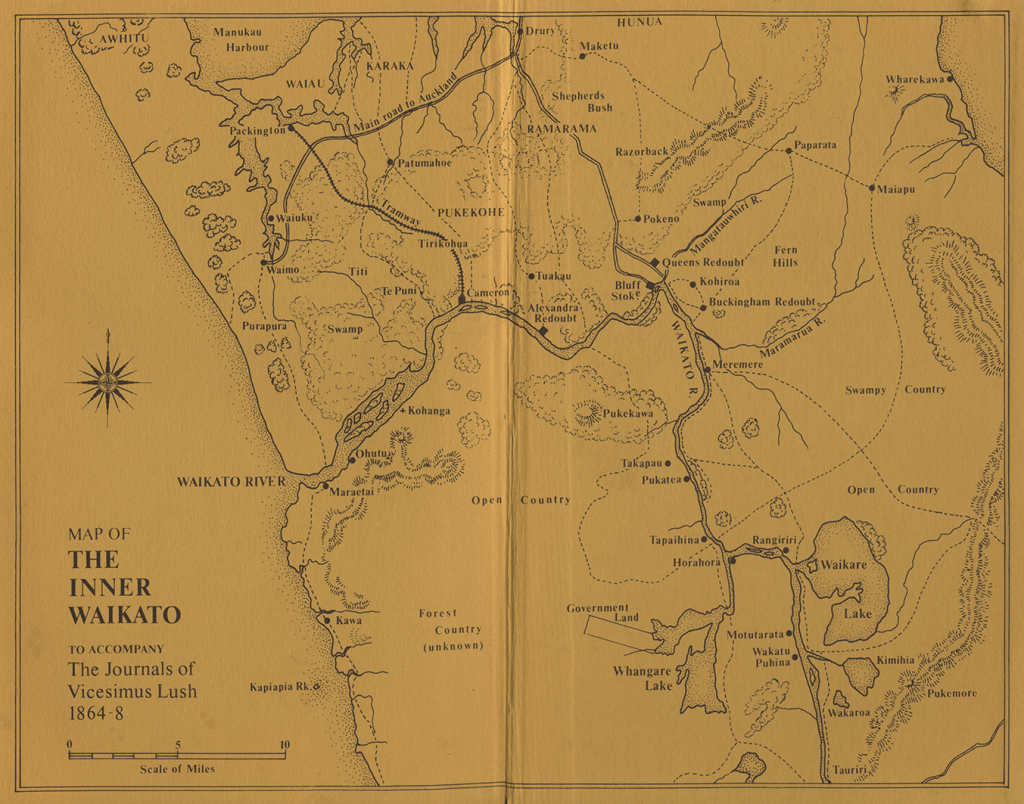
During the war years the New Zealand Government passed a Bill intended for the protection of “well disposed Inhabitants of both races”. A proposal was made for the establishment of settlers, grouped in numerous small settlements, who would be required to defend themselves and to serve wherever they might be ordered to go within New Zealand. One year later in December 1864 the Government proclaimed the acquisition of all lands taken by Her Majesty’s armed forces, and the confiscation of all Waikato country east of the Waikato River and north of the Puniu. This meant that apart from about six thousand acres near Waiuku nearly all the previously Maori-owned land was ceded to the Crown; no attempt was made to wait for the sitting of the Maori Compensation Court. By 1864 the Waikato Regiments were established on military settlements as far south as Te Awamutu, and the Government was able to give its attention to the Special Waikato Immigration Scheme.
Early the same year the ship Light Brigade, bound for England, carried two men who were to advise agents in England, Scotland and Ireland on the selection of suitable immigrants to be located on land south of Papakura and in the outer Waikato. These were John Martyn of Ramarama and Joseph May of Auckland. Later William Berg of Capetown sponsored a small group of South Africans, to be known to their fellow-settlers as “the Cape pigeons”.
Arrangements for the reception of these people were not entirely without imagination. An effort was made to consider their comfort on the voyage out and it was promised that “the scale of dietary shall be liberal”. The intending emigrant was warned that at first he would not be able to live upon the land granted to him. An “amount not exceeding £15” was offered for the building of his house – to be repaid by monthly instalments. At this stage the inevitable happened and the Government of New Zealand discovered that a hoped-for loan of £3,000,000 was not viewed kindly on the London stock market. Consequently the estimate of settlers to be accepted declined from twenty thousand to a mere three thousand.
The first ship to leave Britain was the Helenslee from Glasgow, on 10 September 1864. She was followed by Resolute and Viola, also from the Clyde, and the Bombay from London. The Bombay contingent named their settlement after this ship, though it does not seem likely they would wish to remember the storm that caused her to be towed into Auckland on 18 March 1865, dismasted, with her sails in shreds – and four hundred passengers aboard. Ships carrying emigrants from the Cape of Good Hope for Mr Lush’s new parish were the Steinwarder which came into port without incident, helped by favouring winds and fair weather, followed by Alfred, Maori, Reihersteig and finally Eveline. In all there were thirteen ships, two of them from Ireland.
As usual there had been delay in surveying allotments for newly-arrived settlers. Arrangements made for their reception had one characteristic in common – the accommodation was universally uncomfortable. Some of the South Africans were taken over to the North Shore to occupy a corrugated-iron shed (formerly used for Maori prisoners), where they stayed for some weeks; others were housed at Onehunga and were fortunate enough to find work in Auckland. They went on to Drury where they lived for a time in disused barracks and worked at roadmaking until their permanent settlements were ready at Tuhimata, Pukekohe and Maketu (now called Peach Hill), east of Drury. The Viola’s passengers had the distinction of being loaded into small boats from their ship and taken up the Wairoa River to Clevedon, Otau (Ness Valley) and Papakura, though they too had their share of miserable lodgings.
Pages 15 and 16
It was not long before the Minister felt the difficulties of the newscomers weighing heavily upon him. The established settlers at such centres as Mauku and Waiuku were beginning to find their feet again after the losses caused by the war troubles of 1863 but the new migrants had nothing but hope to sustain them and that was wearing thin. Equipped with unostentatious gifts of food and clothing – and with such advice as he could conscientiously impart – Vicesimus Lush steered his way through his parish where only a handful of settlers were in a position to contribute to his small salary, much less subsidise their new neighbours by offering money for work that would have been of value to both parties.
By 1866-7 the immigrants were not the only ones to find themselves in serious difficulties. In a depressed Auckland people were queuing at soup kitchens, but within the Inner Waikato farmers, barely recovered from the war but thankful for small mercies, were beginning to come forward with practical help. Odd jobs that earned the little the employer was able to pay were offered and accepted thankfully. Church attendance improved; ragged garments kept many a mother from church though she could send her bare-footed children in cut-down remnants of her own dresses and feel they did her credit. It is awesome to recall that even the simplest garment meant hours of hand-sewing – that the practice of “turning” a dress or coat required careful unpicking of all seams until the material could be reversed and sewn up again with the close, fine stitches that hard wear demanded. This turning process was sometimes done as many as three times.
Page 17
The first quarterly report received by Bishop Selwyn for the Diocesan Records in September 1865 outlines the strenuous life of his new priest “The following districts, viz. Waikupa Creek, Turanga Creek, Wairoa [Clevedon], Wairoa Road [Ardmore], Drury and Papakura – and the new settlements of Kerikeri [Kirikiri], Maketu, Bombay, Paparata, Williamson’s Clearing and Tuakau I have visited, I think I may say thoroughly, for I believe there is not a family belonging to the Church residing in them which I have not called upon and many of the families two or three times. Bombay (or Paparata as Mr Bowling calls it) is the new Immigrant settlement about a mile beyond Williamson’s Clearing on the East side of the Great South Road. I have also visited, but as yet in a less thorough manner, Waiuku, Mauku, Pukekohe, Pokeno and Otau [Ness Valley] and, for the sake of learning the route and distance, I have also paid a hurried visit to Port Waikato. I have stated to the people at Maketu and Bombay my willingness to hold a week day Service once a month, directly the government have erected the School house promised to each settlement…. Mr Donaldson, the Manager of the Maketu settlement, pointed out to me a very desirable site for a Church the top of a knoll in the centre of the village. He thinks it can be purchased as a Church site for a very moderate sum…. At Waiuku the highest spot in the village, the spot on which the Redoubt was made, is now for sale.”
This well compiled assessment appears to have impressed the Bishop though it is likely to have stirred some uneasiness in the minds of those Diocesan officials who controlled the almost non-existent finance available for even the most modest schemes. But a century ago both self-help and enterprise were usual and successful. On 22 August 1866 Mr Lush and Mr Kempthorne were out early in the morning “begging for our new Church of St Peter’s in the Forest [Bombay]” from the citizens of Auckland and even farther afield as this extract from a letter dated 23 September 1868 from Mr Lush to his cousin Selina shows:
“At this present moment we have but one ill in our family – dear little Anne, and she is convalescent: but at times we have had much and serious illness: especially with poor Charles. By the way, Selina, I have to thank you for a donation of £5 to any one of my numerous (poor) churches – many thanks, very many – I have devoted it to St Peter’s in the Forest and intend it as the very first commencement of an endowment for that Church – a sort of ‘nest egg’ around which other gifts may accumulate. If you see your way I shall have no objection to your making the gift Annual – There now – call O’Connell the big beggar man – have not I surpassed him?”
Page 19 and 20
20 May. 1865. A boisterous and somewhat chilly day. Called at the Hargreaveses’ – Constance is delighted at leaving Howick, she hopes to go on the 22nd: her Mamma and the rest of the children will leave soon afterwards. They have not had, I should think, a pleasant residence in the village: the Peacockes’ pride and the Seddons’ coldness would help to make any one’s stay unpleasant if they were, as the Hargreaveses are, of a sociable turn.
A hundred immigrants just landed have been sent here. The Government found them lodgings and give them rations for a time till they can be sent forth to their own grants of land.
Page 49
(My Notes: Reverend Lush is referring to the Bombay settlers arriving in Drury, his residence being Parsonage Cottage )
19th July.1865. The first tolerably fine day for the last 6 or 8 weeks.
Page 51
(My Notes: It would appear the Bombay settlers had awful weather as they lived in tents or barracks)
JULY-AUGUST.1865. After breakfast and after washing up and sweeping out of 3 small rooms, I started for another of the immigrant settlements about 9 or 10 miles from Drury. These people came in a vessel called the Bombay – so they go by the name of “Bombays”. The Superintendent has located these people in the Forest: he employed the men in opening up roads through the Forest – one road about 3 miles long by two chain wide is completed and being in a straight line and with a gradual ascent for about 2 miles, I think I never saw so beautiful a vista through a mass of magnificent trees as presented itself to my view when I reacht the entrance of the Settlement.
On either wide of the road the Immigrants are to be located, each having 10 acres of land: many of them have cleared perhaps a quarter of an acre, some more – some only just sufficient to build a little hut. They are all at present living in huts formed of the huge leaves of the Nikau: they seem very contented – were evidently pleased to see a clergyman — all but two are members of the Church. Of these one is a Scotch family and therefore Presbyterian and the other Irish and Romanists. The rest are from Dear Old England. One of the good people let me share their dinner: another family kept watch for my return from the further extremity of their long road, and had tea ready for me.
I visited 17 single men and 16 married people – in all I found there were already located there 75 souls – and as many more to come as fresh roads through the forest opened. Several of them asked me the Bishop’s name, – and for three of them I had to write it down.
Page 52
17th of August.1865. Spent the whole day visiting another immigrant settlement called Paparata. This has been a laborious day: the ride was 9 miles there, 18 in all.
18th of August.1865. Went to Paparata one of the new immigrant settlements: had my horse to the settlement, but the visiting was on foot – the roads through the forest where the people are located are in a frightful state: every step I took was over my ankles in sticky mud, so my progress was slow and wearisome. Baptized two children – found the poor people were very discontented and almost all wished they had never left the Old Country. Returned to my “Headquarters” very tired.
Page 54
(My Notes: Reverend Lush interchanges the Bombay settlement with other names)
14th of October. 1865. Started for the Queen’s Redoubt, visited Paparata on my way – distributed medicine to some folk ill with chronic complaints: reacht the Redoubt about 5. The Major (Miller) received me with his wonted kindness and I spent a pleasant evening – the Mess is reduced very low – there were but Major Miller, Dr Lamb and myself.
Page 62
(My Notes: Paparata was the Bombay settlement)
8th of Febuary. 1866. Started for Tuakau: stopped at the Paparata settlement on my way. It was evening before I got to Tuakau – most of the people are still living in tents. Mr Benjamin Harris had promised me a lodging so I rode to the place where he put up. It was, I found, a long corrugated-iron store divided into two rooms by a low partition: the first was furnished with a counter and served as a shop, and was crowded with Groceries, stores, &c. – the hinder room served as a Kitchen and eating room and sleeping room: I wondered where I was to sleep but kept my wonderment to myself.
Page 67
15th of June.1866. Started for the Queen’s Redoubt. Then proceeded to the settlement about a mile beyond “Williamson’s Clearing”, called by me “Paparata”; by some the Bombay Settlement. This is the third monthly visit I have paid these poor people, so they begin to know me and I them. They are all in a dejected state: when in England they were told that not only would they have 10 acres of land given to them free, but work found them by the Government for 12 months: they have not yet been here 6 months and at the end of this month the wages and work will cease, and privation and suffering stare them in the face for the Government have overdone it and there are such a large number of – I was going to say Paupers – but of poor working people without a shilling of their own lately brought out – some from England but chiefly from Scotland and Ireland – that there is not work enough in the Colony from private people to employ them, and the province and Government are nearly bankrupt. I left them with a heavy heart for I could not advise them, not knowing what to suggest.
Page 86
28th of July. 1866. After dinner I went to the Bishop’s and collected Zingarie and, heavily laden, started with a still heavier heart from home, on my usual monthly tour. The evening turned out wild and wet but fortunately I reached my Hermitage before the rain came down. The greater part of the last two weeks I have spent at Parnell – ten whole days: now I am on a tour which will occupy me for the next three weeks. Three of the ten days I spent with Mr Kempthorn, begging from house to house in Auckland for subscriptions to build St Peter’s in the Forest: a new Church Mr K. has taken in hand and which he wishes to see erected on 5 acres he has made over to the Bishop. Adjoining these 5 acres Mr Ashwell has given 10, so if the scheme succeeds and eventually a Parsonage should be built, the clergyman would have a glebe of 15 acres. This site is beautifully situated half-way between Drury and the Queen’s Redoubt.
29th of July. 1866. After a very stormy night we have had a splendid day. Rode to where St Peter’s some day (soon perhaps) will stand and had Service to a few of the settlers. A Miss Martin was present and she asked me to return with her to her father’s and have dinner in the evening. I called in at Sir Frederick Dean’s and had tea with him and his Lady.
(My Notes: Miss Martin was most likely either Elizabeth or Catherine Martin, passengers on the Bombay)
Page 90
1st of August.1866. Went to the Settlement I hitherto have called Paparata, but I find Paparata is some 12 miles off and that its right native name is “Ramarama” – by the settlers it is called “Williamson’s Clearing”, a settler of the name of Williamson having long ago felled a small portion of the forest: by the Immigrants it is called the “Bombay Settlement”, the ship which brought them hither having rejoiced in the name of Bombay — I shall do my best to establish the native name Rama-rama and as a beginning I entered that name in the certificates of Baptism.
I spent the whole day among the Immigrants – they seem to take a lively interest in the proposed new Church of “St Peter’s in the Forest” which will be within a quarter of a mile from their chief road. The day was beautifully fine, ending with a magnificent sunset, about which time I noticed that the Parrots made more than usual noise and flew about among the tree-tops in a most excited manner. I passed over a hill composed of very singular-looking earth, a dark rich red. A man who was with me said it was to a considerable depth all the same colour. I took some up and it felt soft to the touch and I found greased the paper in which I had wrapped it up. The man further told me it was particularly fertile: certainly his garden – as far as he had gone – could not have looked better.
Page 91
13th of August. 1866. Had also a letter from Mr Browne at the Wairoa, asking me to get him a servant so I rode to Ramarama and secured a daughter of a Mrs Sawyer, promising to pilot the young woman to Mrs B. if she would walk to Drury this evening, so as to start with me tomorrow morning, for as Mr Browne lives fully 10 miles from Drury and as Ramarama is at least six I knew she would scarcely be equal to walk 16 miles.
16th of August. 1866.. After breakfast I rode over to Mrs Warden and told her I would ride slowly towards the Wairoa and Lizzie Sawyer must follow. I had not gone half a mile ere the young woman overtook me and I fastened her “swag” to my saddle and she followed as she could. She was evidently wearied by the time we reached the Thorps’ so I dismounted and she got up and rode the rest of the way. Mr and Mrs Browne were surprised and pleased at the promptness with which I had answered their letter: but I let them know that the pleasure I had in revisiting the Wairoa had a good deal to do with my exertion in securing Sawyer, for without such a job I should have had no excuse to leave my own district to trespass, as it were, into Mr Hall’s parish.
Page 92 and 93
(My Notes: Lizzie Sawyer was none other then Elizabeth Caroline Sawyer aged 12, who had travelled on the Bombay with her family)
27th of July. 1867. Called at my caravansary and prepared the place for Mr Kempthorne who will occupy my rooms tonight, gave Zingarie a good feed and then rode on for St Peter’s, which is to be opened tomorrow. To my dismay I found nothing in the building but 12 long forms each 12 feet long. The builder was present so I asked him “Is there no reading desk?” – “No Sir, not in my contract” – “No Communion table?” – “No Sir, not in my contract. I contracted for nothing save the nave of the Church: and I have made the 12 forms and present them as my donation.” So I thanked him for them but begged him to put up at my charge a reading desk and a Communion Table – he thought there was no time – but after a bit he said they should be done. Thence I went into the Settlement and informed the people that there would be Service in the new Church. I found there would be two Christenings and I borrowed a huge Table-cloth from one of the immigrants.
6th of August.1867. The Southern Cross gives a flourishing account this morning of the new Gold field: already some of the young men have left Drury for the Thames. Rode by the Great South Road to Pokeno – spent the whole day visiting.
7th of August.1867. Retraced my steps, visiting those whom I had missed yesterday. Found a strong “gold fever” seizing the people:
Page 119
21st of September.1867 Rode to St Peter’s in the Forest: the late gale it seems has damaged the building and the Carpenter had erected scaffolding inside to get to the cross-timbers and brace them and strengthen them: so I had to go round and inform the people that there could not be any Service tomorrow – and my weary ride hither has been in vain. Returned to Drury, calling in on my way at the Deans’ where I had my tea and brought away with me a root of a pink chrysanthemum – we now have white, yellow and pink ones.
Page 121
28th of September. 1867. Rode to St Peter’s in the Forest. There was a meeting in the evening about establishing a school: upwards of £30 promised towards building a Teacher’s residence. Returned with Captain Jackson 73 to his house, where I slept.
Page 122
8th of October.1867. Went to Maketu to baptize a baby: found the people very discontented at the Bishop drawing lots with Mr Norrie as to who should buy the Government School House: the lot fell to Norrie, the Presbyterian, and when I get St Peter’s off my hands I hope to turn my attention to Maketu – without consulting the Bishop this time. From Maketu rode on to Captain Jackson’s – 2 miles beyond St Peter’s Church.
9th of October.1867. Captain Jackson and I made a long day, going from Settler to Settler begging for subscriptions to build a Teacher’s residence so that by next Xmas we may begin a School in connection with St Peter’s Church: the sum we want is £50. At Pokeno hill he and I parted – he returning home, I going to Dr Weekes’s. Mrs Weekes still in town.
Page 124
24th of November. 1867. A most tempestuous night – rain, wind, hail and thunder continuously. The morning broke very gloomily and there was great doubt as to whether Blannie should accompany me [to Church]: the Weekeses and Miss Ormsby determined to remain at home. However, the sun coming out though rather feebly, Blannie and I set out. There were but 6 persons present: it was a treat to me to hear Blanny’s clear, musical voice in the chaunts and hymns. There was one storm during service and then it became finer and we went on towards St Peter’s Church, Ramarama [Bombay], but near the foot of the Razorback another storm burst upon us and though we galloped to the top, where a small store is, we both got sadly wet: we sheltered ourselves [in] the store till the storm was over, Mrs Pope the owner of the place attending to Blannie and wringing out the water from her riding-dress: then we went on to the Proudes’, where Blannie got some dry things and we had dinner. Mr Proude was for none of us going out again, feeling sure there would be no one at Church but Captain Jackson called in on his way to the Church and said he saw 2 or 3 people standing about waiting for me: so, leaving Blannie by the side of a good fire and with Mrs Proude, we three gentlemen went to St Peter’s, where I had a congregation of nine. After Service Blannie and I started and by dint of hard riding got to the Weekes’s without rain, though a storm was impending all the way, and before we had been in 5 minutes came down in torrents.
This has been a most remarkable year as regards the weather – it is now six months! since we had settled fine weather
Page 131
21st of Febuary.1868. Remained at home since the 17th. This morning drove to Drury thence rode to Razor-back hill and spent the evening with the Jacksons: here I learnt disastrous news as regards our proposed school in connection with St Peter’s in the Forest. Captain Jackson, Mr Proude and myself have collected 65£ to build a Teacher’s residence – intending immediately the house was finished to secure the services of a Teacher and to open a school. We had called upon a Mr Martyn (a Wesleyan) and a Mr Rutherford (a Presbyterian) and they had promised their assistance, and apparently took an interest in the project, but a fortnight ago had engaged a lady as a Teacher and Mr Martin had given her and her husband a cottage near rent-free, and they had stolen a march upon us and opened a school in opposition to the one we proposed. I must admit of being intensely disgusted, but as I cannot do the business single-handed there is nothing for it but to grin and bear it.
23rd of Febuary. 1868. Called a meeting after service and again urged upon the Committee to go on with the building of a Teacher’s residence – but in vain. The only point I gained was that the money in hand should not be returned immediately to the donors, but retained by Captain Jackson for six months, in case the dissenters’ school should fail and so again leave the field clear for us.
Page 142
26th of September. 1868. Spent all day in the Settlement – almost all the men have left for the diggings – some of them have sent sufficient money home to their wives to purchase cows – pigs – &c. So, though the village is not near so populous as it was it has a more thriving appearance. On returning to Captain Jackson’s I was introduced to a Mr Moore – the son of a Wesleyan
Page 153

 THE SHIP BOMBAY!
Leave a comment